
AI Process Workflow Model Mapping For Healthcare

Transforming Healthcare
Streamlining processes can enhance patient care and operational efficiency

Home > AI Process Workflow Model Mapping For Healthcare

About us

Improving Healthcare Processes

Process improvement in healthcare is essential to delivering high-quality, cost-effective, and patient-centered care. With rising operational costs, increasing patient demands, and evolving regulations, healthcare organizations must continuously evaluate and enhance their workflows, procedures, and systems. Effective processes help eliminate inefficiencies, reduce medical errors, shorten patient wait times, and improve communication among clinical and administrative staff.

Process improvement supports better resource utilization. From managing staffing levels to optimizing inventory and equipment usage, healthcare providers can make informed decisions that lower costs while maintaining high standards of care.

Process improvements cannot take place until the baseline as-is process is defined. The AI Process Mapper reduces the time and effort needed to create as-is process models by over 40%. This accelerates every process improvement project and gets the project team quickly focused on looking for process improvements. Cost reduction in healthcare is no longer just about cutting budgets — it’s about rethinking how work is done. Process reviews powered by AI technology such as the AI Process Mapper, are empowering healthcare organizations to create more efficient systems that can deliver high-quality care at a sustainable cost.

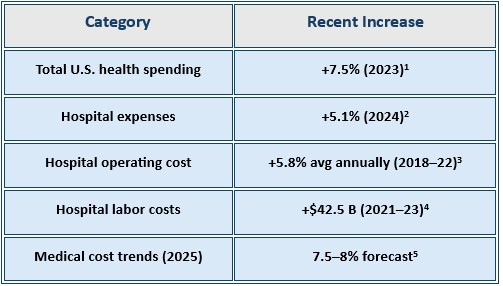
The healthcare industry is under mounting pressure to reduce costs while improving the quality of patient care. Across the board, healthcare operational costs are rising significantly faster than general inflation, stressing budgets across hospitals, medical practices, insurers, and patients alike.
The table illustrates a persistent, multi-year trend. To combat this, health care organizations are increasingly reviewing and reengineering their internal processes to identify inefficiencies, eliminate waste, and streamline operations. Healthcare organizations are doubling down on strategies like Lean Six Sigma, digital transformation, and AI to restore financial balance and ensure affordable, efficient care delivery. These process improvement tools are being tailored to healthcare environments to reduce variation, improve patient flow, and eliminate non-value-added activities.

It all starts with reviewing existing processes, the foundation of every organization’s operations – how they get work done. Creating a clear and understandable process model that illustrates the people, processes, activities, and interconnections is the first step to improving a process. Traditionally, facilitated meetings or structured Kaizen events were used to create the as-is process model. This approach is labor and time intensive, taking professionals away from their everyday work and adding stress. This meeting methodology is not designed for today’s healthcare operational environments.
Instead, organizations are turning to AI tools like the AI Process Mapper to create their as-is process models. This tool instantly converts documents and text into process models. The application identifies actors, activities, and decisions, and places them in swim lanes using BPMN notation. Documents such as SOPs, training instructions, email messages, and raw text can be entered and converted into highly accurate as-is process models.

  • [1] McKinsey (https://www.mckinsey.com/industries/healthcare/our-insights/what-to-expect-in-us-healthcare-in-2025-and-beyond)
  • [1] AHA (https://www.aha.org/costsofcaring)
  • [1] Baker Institute (https://www.bakerinstitute.org/research/prices-versus-costs-unpacking-rising-us-hospital-profits)
  • [1] AHA (https://www.aha.org/guidesreports/2025-04-28-2024-costs-caring)
  • [1] PWC (https://www.pwc.com/us/en/industries/health-industries/library/behind-the-numbers.html)